
Beyond the Series: The Ongoing Reflections of an Autistic Trans Woman in Harmony with Her Identity
Reflections on gender, neurodivergence, and the quiet unfolding of self—one gesture, one article, one discovery at a time.

A living archive of reflection from an autistic trans woman tracing their first year of recognition—and beyond. Not a roadmap, but a symphony-in-progress. These are notes from a life unfolding, in language finally becoming available.
Introduction
It’s been over a year since I first created this page—and at the time, in the haze and urgency of early coming out, writing was how I breathed.
My gestalt processing, hyper-empathy, and uneven access to functional spoken language often made verbal communication unreliable. But writing? Writing gave shape to the storm. Articles would arrive in a rush—paragraphs forming faster than I could type—insisting on being caught before they dissolved. What began as a few scattered reflections quickly became a flood.
I never set out to write a series. It simply happened. One piece called forth another, and before long I was in an ongoing conversation with myself—past, present, and newly recognisable. This page became a way to gather those threads. And although the pace of writing has changed, the reflections have not stopped. The series did not end. It deepened.
Over time, the words have come more slowly, but also more clearly. The panic-drenched urgency of those early weeks has softened into something roomier, steadier, more deliberate. I still write as a form of processing, but the voice I hear now is less frantic and more rooted.
And perhaps that is the important distinction. I no longer think of my life in terms of “transition” as a verb. Trans is not something I became. It is an adjective. A truth of my being. I have always been trans—not cis—even in the years when I did not yet have the language, permission, or coherence to say so aloud. What happened was not transformation into someone else, but reconciliation with who I had already been all along.
That is why this archive now reads differently to me. It is not a record of “becoming trans” so much as a record of recognition—of memory surfacing, pattern resolving, fragments drawing into relation. HRT has certainly brought material and physiological change, and with that, greater emotional access, narrative clarity, and a deepening sense of embodiment. But the deeper movement has been one of alignment. What once felt like survival now feels more like return.
This collection is no longer only about those first intense months of coming out. It has become a living archive of reflection—spanning gender, autism, language, ancestry, intimacy, resistance, and joy. Each piece is a note in a larger symphony of selfhood: not linear, not tidy, not reducible to a before and after. I expect that symphony will continue to unfold—in strange harmonies, recursive motifs, and unexpected keys—for years to come.
As always, my story is only one among many. I write not to define a “trans experience,” but to contribute my voice to a polyphonic chorus—messy, beautiful, unfinished. I am proud to be part of a community in which no two lives resolve in quite the same way, and where every voice matters.
So whether you are new to my writing or have been here from the beginning, welcome. The pieces below are listed in the order they were written. They are not steps on a path or chapters in a tidy narrative. They are moments. Scenes. Gestalts. Pieces of a life caught in language—shared in the hope that someone else might glimpse a pattern of their own reflected there.
Thank you for reading, sharing, and supporting The AutSide.
A Note on Voice and Perspective
What I have written here, I have written from the inside.
These pieces are not declarations so much as reflections—attempts to render something honest and immediate from within the lived texture of my own life. They are not universal statements. They are field notes from one particular bodymind, one particular history, one particular set of recognitions.
Language—especially English—has never been native to me. I did not acquire it in the tidy, expected way younglings are supposed to, and it still does not arrive as instinct. It often arrives instead as effort, pattern, texture, and approximation. Even now, I write not because language is effortless, but because writing gives me a way to shape what spoken language so often cannot hold. I have done my best to craft each sentence with care, trusting that meaning does not always live in perfect precision. Sometimes it lives in presence. Sometimes in resonance. Sometimes in the pattern that emerges only when the whole has been felt.
This collection of essays, and the life they reflect, is one thread among many in the vast and varied fabric of trans existence. My understanding of femininity is shaped through a specific and intersecting lens: as an autistic, gestalt-processing, hyper-empathetic, alexithymic, transfeminine person. My life bends through those conditions. It will feel deeply familiar to some readers and utterly unlike their own experience to others. That is not a flaw in the telling. That is the reality of human plurality.
If you’ve met one trans woman, you’ve met one trans woman, once.
I hold that as both truth and ethic. I respect other trans people as they name themselves. Their pronouns, their identities, their boundaries, their histories, their routes to recognition, their relationships to language, body, medicine, visibility, and belonging—all of it is theirs. None of us are made more real by forcing ourselves into a common script. We are made more possible by making room for one another’s specificity.
That is why I do not share these reflections as prescription. I am not offering a template for how to be trans, autistic, queer, or anything else. I am offering a voice. One voice in a much larger chorus. My hope is simply that it contributes—clearly, honestly, and without apology—to the collective music we are all making. Not by collapsing difference into sameness, but by recognising that harmony depends upon distinct notes.
What I have found in trans community has been breathtaking in its variety. There is no one way to be a woman. No one way to be transfeminine. No one proper relationship to the body, to dysphoria, to euphoria, to clothing, to names, to pronouns, to disclosure, to history, or to embodiment itself. Some people speak in certainty. Some in experimentation. Some in grief. Some in joy. Some in a register the world has no patience for, until it does. That diversity is not incidental. It is the point.
As I continue to live more fully in the truth of myself—as an autistic trans woman, as a queer transfeminine person, as someone whose language has always come sideways and whose knowing has always been field-first—I do so with gratitude. Gratitude for the people I have met. Gratitude for the stories that widened my own. Gratitude for the spaces where difference is welcomed instead of interrogated. I want to keep listening. I want to keep learning. I want to keep making room.
And if what I have written here resonates with you, I am honoured. If it does not, I am still honoured to stand alongside you as one voice among many. We do not need to mirror one another to belong to the same community. We do not need matching narratives to recognise shared stakes. We only need enough humility, enough courage, and enough care to let each other be real.
There is no one right way to be trans.
There is no one right way to be human.
But there is power in refusing the lie that difference requires hierarchy.
And if writing all of this has taught me anything, it is this:
Our stories do not compete.
They deepen one another.
The story’s links
The articles are listed in the order in which they were written. Start at the top and read down to follow my journey.
From Coming Out through the First Year of HRT
Unmasking the Divine Spark: A Kaleidoscopic Journey of Identity, Memory, and Self-Discovery.
Resonating with My Truth: A Journey of Vibrational Becoming.
The Harmony of Being: Finding Resonance at the Intersection of Autism and Transgender Identity.
Building New Gestalts: Navigating the Unprecedented Experiences of a Life in Transition.
Squaring the Circle: Integrating Transgender Identity and Masonic Principles
Retrocausality and the Rewriting of Gestalts: An Autistic Trans Woman's Perspective
The Struggle is Real: Shopping for Clothes as a Tall, Autistic Trans Woman.
Stitching Ancestry into Self: Designing a Life Inspired by the Colours of the West Highlands.
The Muted Life: Grey Rocking as Survival for an Autistic Trans Person in a Hostile World.
Reclaiming Threads: My Journey of Decolonizing Femininity and Embracing Indigenous Roots.
Bespoke and Beautiful: Tailoring a Path to Authentic Self-Expression.
Enhanced Empathy and Receptivity: The Harmony of My Transition.
Reconnecting with My Body: An Autistic Trans Woman's Journey of Awakening.
Rewriting the Script: An Autistic Trans Woman's Reflections on Her First Week of HRT.
Chiseling Away: How Freemasonry Helped Me Discover My True Identity.
Building New Gestalts: Navigating the Unprecedented Experiences of a Life in Transition.
From Noise to Harmony: The Profound Impact of HRT on My Mental Clarity.
Stitch by Stitch: Progress in My Heritage-Inspired Clothing Project.
Patterns of Self: Unraveling Gender Dysphoria Through a Neurodivergent Lens.
Breaking the Chains of Brotherhood: A Trans Woman’s Spiritual Exodus from Masonry.
Hormones and Harmony: Unravelling the Science Behind HRT's 'Calming Effects.'
Beyond Size Charts: Crafting Comfort and Confidence as a 6'7" Autistic Trans Woman.
Navigating the Uncharted: HRT and the Panic of a Gestalt Language Processor.
The Well at the End of My World: A Trans Journey Through Folklore.
Autistic, Trans, and Revolutionary: My Transition as Reclamation.
Finding My Voice: HRT’s Surprising Effects on Language and Clarity.
Transitioning Beyond Pretence: Living Authentically as an Autistic Trans Woman.
Fueling Change: How My Diet May Be Accelerating My HRT Journey.
The Ankh of Becoming: A Trans Woman’s Reflection on ‘Jessica 6.’
The Periods We Create: Lived Experiences, Lack of Research, and Transphobic Narratives.
Between the Lines: The Life and Liberation Behind The AutSide.
The Last Person Before Gender, the Fractured One, and the First Child of the Next World.
Still Here, Still Queer: Neuroqueerness, Utopia, and the End of Empire.
They Call Me Bitter: On the Mistranslation of Autistic Emotion.
The Edge and the Mirror: On Tala Brandeis, Trans Womanhood, and Erotic Truth.
The Cailleach Returns: Trans Femininity, Dangerous Wisdom, and the Terror of Unwritten Womanhood.
The Second Year of HRT
A Slow Homecoming: Through Fire, Through Water, Through Flame.
Ein Augenblick: A Theatre of Gestalts. (Part 1 of 3)
Refusing the Elevator Pitch: On Reciprocity, Resonance, and the Ethics of Understanding GLP Minds. (Part 2 of 3)
The Cartographer’s Return: GLP Minds in the Classroom. (Part 3 of 3)
What the Skin Remembers: Transition, Nourishment, and the Refusal to Perform.
The Long Return: On Femmeness, Stone, and the Memory That Would Not Die.
Write Wyrd Stuff: On Writing the Way My Brain Was Made to Think.
Autistic Justice: Remembering the Child the State Tried to Forget.
Uncontainable: An AuDHD GLP Responds to the Prompt—“I Am ...”
The Future That Was Always Here: Becoming Seen, Becoming Sound.
Learning Touch Late: Sensory Residue From The Body We Were Never Taught To Inhabit.
Quantum Language: Barad, Gestalts, and the Ethics of Entangled Knowing.
The Curriculum of Touch: Autism, Attunement, and What the Studies Never Taught Us.
Selective Depth: Queerness, GLP, and the Refusal to Be Extracted.
When the Files Reopen: Gestalt Memory, HRT, and Writing from the Body.
Dressing for Attunement: Bringing Inside and Outside Into Agreement.
The Third Year of HRT … and Beyond
… and the “series” doesn’t really conclude there.
Oh, Yah. Another Thing.
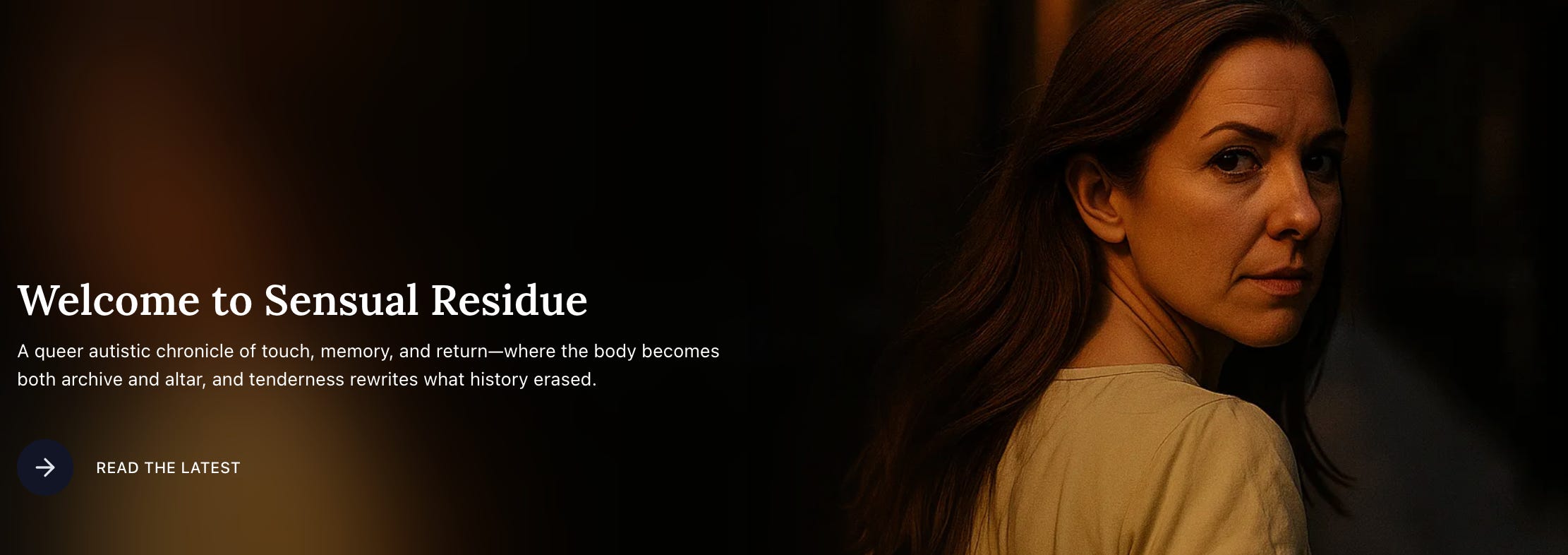
Out of this same body of writing has emerged another branch—Sensual Residue—a quieter, more tactile archive. Where The AutSide moves through critique and revelation, Sensual Residue lingers in touch, memory, and the sacred pulse of queer embodiment. It traces the sensory language of becoming—how attunement, desire, and presence intertwine in autistic and trans experience. The pieces there are not confessions, nor instruction; they are residues of feeling, moments where body and world briefly dissolve into one another. Sensual Residue is where the political meets the intimate, where theory breathes through skin, and where the Afterglow of experience becomes its own form of knowing.
Next Steps …
As I move further beyond the second year since coming out, one thing has become unmistakably clear: the tempo has changed.
In the beginning, the writing came in a flood. I was trying to breathe, trying to orient, trying to catch language fast enough to keep pace with what was surfacing. Piece after piece arrived with an urgency that felt almost bodily. I did not so much decide to write as find myself being written through. Looking back now, I have probably produced two books’ worth of material from that period alone—an outpouring of recognition, memory, language, embodiment, grief, joy, and astonishment.
That rush is no longer where I live.
And I say that not with sadness, but with relief.
What those first years required, they gave. The writing helped me build coherence. It helped me name what had long been felt but not yet gathered. It helped me survive the shock of visibility and the strange delight of finally being recognisable to myself. But now, the pace has slowed. The panic and pressure that once drove so much of the work have softened. The need to narrate every shift in real time has receded. What remains is not absence, but steadiness.
I think part of that is simple: I have more scripts now.
Not scripts in the old sense of camouflage or compliance, but scripts in the sense of access. Usable language. Settled patterns. Reliable ways to move through social space without having to invent myself anew each morning. Confidence has grown in their wake. The world has not become simple, but I am less often caught without words. Less often stranded at the threshold of my own life. There is a particular ease that comes from no longer needing to explain your existence from first principles every time you speak.
So if the writing appears less frequent now, that is not because the story has ended. It is because the emergency phase has passed.
What once arrived as surge now arrives as ripening.
I still have things to say. Of course I do. There will still be essays, reflections, field notes, moments of reckoning, moments of delight. But they come differently now. Less as a flood, more as weather. Less as compulsion, more as invitation. I no longer feel the same need to document every contour of early recognition. I have already done much of that work. The archive exists. The pages are there. The voice is here.
And perhaps that, too, is part of what changes after coming out. Not that one stops learning—far from it—but that the learning becomes less explosive. Less about revelation. More about inhabitation. Less about finally saying this is who I am. More about the slower, subtler practice of living inside that truth across time.
What matters to me now is not to repeat that I reject “transition” as a tidy verb. I have said that elsewhere. What matters here is something more literal, and more exact:
I have never been cis.
That is the clearest language I have for it.
Trans, for me, is not primarily the name of a journey or an event. It is an adjective. A condition of being. A truthful description of the relationship I have always had to the body, role, and social assignment I was given. I was never a cis man who later became something else. I was a trans woman without the material means, language, or safety to fully explore what that reality asked of me. The underlying condition was already there. What changed was access.
I have never been oriented to this conveyance my energy has been provided.
That body was never neutral terrain. It was never a simple or seamless home. Nor was it proof of cisness. It was the form through which I had to move, the available vessel under the conditions I was born into, the site where social expectation and inner truth met in friction, improvisation, longing, and adaptation. For much of my life, I did not yet have the resources—social, emotional, relational, financial, medical, symbolic—to ask that friction what it meant. I did not yet have the safety to investigate it honestly. I did not yet have enough room to proclaim what, in retrospect, had already been structurally true.
But structurally true is still true.
And the more I write at Sensual Residue, the more visible that becomes.
What I find there is not a new self being invented retroactively. I find evidence. Pattern. Repetition. Orientation. A long record of non-cis existence lived before I had the stable language to describe it. In the clubs. In the intimacies. In the garments. In the erotic charge. In the social currents. In the body’s affinities and refusals. In the ways femininity kept attaching itself—not always in recognisable or sanctioned forms, but insistently, persistently, unmistakably.
That series has become, among other things, an archive of pre-declaration truth.
Not hidden truth, exactly. Not in the dramatic sense. More often it was simply truth without infrastructure. Truth without permission. Truth without safety. Truth without the material means to be explored as fully as it deserved. I can see now that so much of what I am writing in this space was already present there—not as metaphor, but as lived signal. The trans woman was not absent. She was operating under constraint.
That is what feels clearer to me now. I do not experience this phase of life as the production of a new self. I experience it as the result of finally having enough means, enough safety, enough language, enough relational ground, and enough bodily access to live in accordance with what had always been the case.
Now I have that.
So I am.
Not because I was not before, but because conditions have changed enough for truth to become livable.
And that distinction matters to me. It matters politically. It matters existentially. It matters because so much of the world still wants to treat trans life as fantasy, deviation, trend, performance, or elective reinvention—as though what is true only becomes real once it becomes visible to others. But visibility is not the source of truth. Safety is not the source of truth. Medical access is not the source of truth. They are the conditions that allow truth to be inhabited.
If anything, what continues now is not “becoming,” but inhabitation. A deeper inhabitation of a life that was always mine. A more coherent relationship to a body that was never cis, even when it was constrained. A more honest reading of a past that, in hindsight, was full of signals I could feel long before I could formally interpret them.
“My coming out story.” I still smile when I say that phrase. But I hear it differently now. Less as revelation, more as materialisation. Less as the birth of something new, more as the moment when an already-existing truth finally acquired enough ground beneath it to stand.
And as I continue in my life as an autistic trans woman, I do so with a quieter confidence—not because all questions are settled, but because I no longer confuse delayed access with absence. I trust the continuity. I trust the patterns. I trust the body’s long memory. I trust the archive. And I trust the fact that what I live now was not conjured from nowhere. It was always there, waiting not for permission to exist, but for the conditions in which it could be fully lived.
Thank you for reading.
Thank you for witnessing.
Thank you for making room.