
The Peer Review That Should Have Happened: Kim (2020) and the Erasure of 40% of the Room
How Literacy Orthodoxy Leaves Students and Teachers Behind

A district PD sold Dr. Kim’s literacy model as settled fact—yet it erases 40% of learners, including GLPs. This is my alternative peer review: tracing its untested roots, naming who’s missing, and reclaiming the maps that truly serve all.
Introduction
Kim, Y. S. G. (2020). Interactive dynamic literacy model: An integrative theoretical framework for reading-writing relations. In Reading-writing connections: Towards integrative literacy science (pp. 11-34). Cham: Springer International Publishing.
It’s the next day—the weekend. The slides are still in my head, colder now—like the echo of a fluorescent hum in a classroom long after the last child has gone home. The air is sharp with the memory of it, a kind of sterile brightness that has nothing to do with light.
Yesterday was district professional development, mandatory by contract, and the chosen fare was module on Dr. Kim’s Interactive Dynamic Literacy Model (I know, how many articles does it take for you to process the trauma of a day’s PD, Jaime). It was presented not as a new idea, not as something still finding its shape, but as settled fact. The cure for our “struggling students.” A framework to solve the problem. The Zoom room nodded along.
I sat there, two streams of thought running in parallel. One was my autistic pattern recognition, operating by default, catching the texture beneath the words, the frequency that hummed between the lines. It was a cold frequency—clean, precise, confident—but with a hollowness that rang louder the longer I listened. The other was my deep professional knowledge in literacy, surfacing the discontinuities as they appeared. A phrase here that didn’t account for lived variation. A diagram there that assumed every child’s path was linear.
From the first slide, I knew what I was looking at: a cure being prescribed that doesn’t even see the patient. A map that insists half the terrain doesn’t exist. The GLP mind—my mind—was absent from the model entirely. Absent not just as an afterthought, but as if it had never even been imagined.
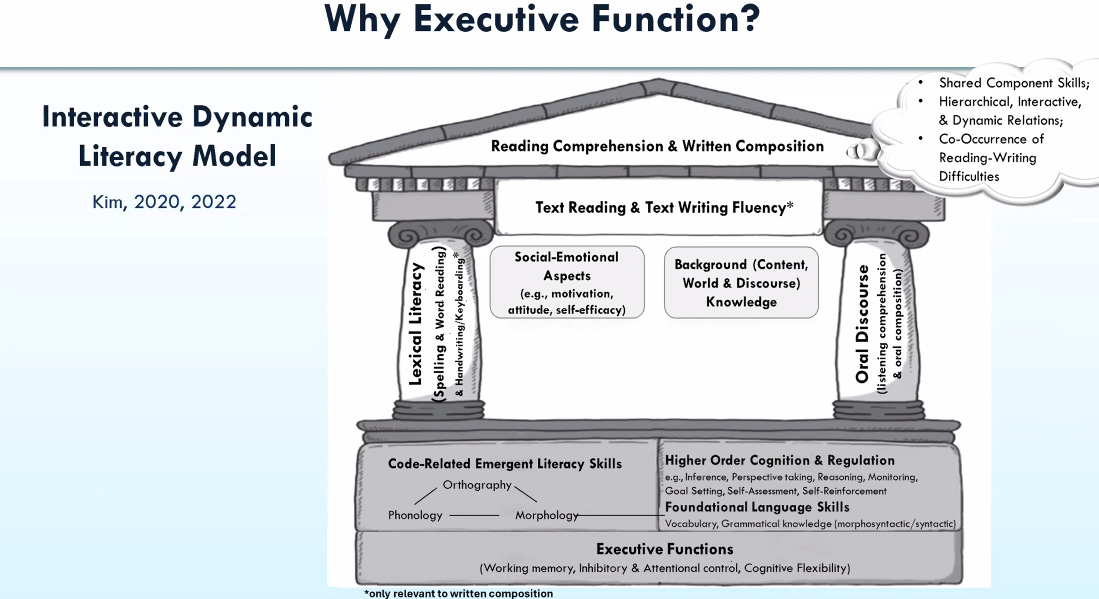
And yet it was delivered with the confidence of gospel, the rhythm of someone who has never been meaningfully challenged. The authority was manufactured, but in that room it was absolute. I could feel myself being written out, not just unseen but mis-seen, as though my way of processing language—and the ways my students process language—were errors rather than possibilities. The familiar ache of being mis-described settled in, a weight I know too well.
The Proposal Itself — What Kim (2020) Actually Is
In the abstract to Kim (2020), the declaration is plain enough—“I propose an integrative theoretical framework…”—but that sentence contains the whole truth of what’s to follow. It’s a proposal, not an empirical study. There’s no fresh dataset. No sample to interrogate. No way to know who might have been included, excluded, or misrepresented. What we have is a model—clean, architectural—built from a mosaic of existing studies, many of them her own.
Her four hypotheses unfold with a certain elegance: a hierarchical structure of component skills, interactive relations both within and between reading and writing, the co-morbidity of difficulties in each, and the idea that these relations are dynamic—changing with time, development, and learner characteristics. They are plausible enough on paper. But as I sit with them, I can feel the déjà vu of their origin points.
Take one passage in Kim (2020) that states children with language impairment, but not those with speech-only impairment, consistently underperform in writing across the year, though their growth rate matches that of typically developing peers. It’s presented here as if it were an uncontroversial, widely reproduced finding. But I know where it comes from—Kim, Puranik, & Al Otaiba (2015)—a longitudinal study of first graders’ writing skills in a very specific context, with outcomes tied to narrowly defined measures of “quality” and “productivity.” It’s an interesting study. It’s also one developmental window, one set of instruments, one set of exclusions. In 2020, that small piece of empirical ground quietly becomes a load-bearing wall in the new framework.
And it’s not just that one. Many of the citations bolstering the 2020 model point back to her own earlier work: on spelling in 5-year-old Korean children (Kim, 2010), on longitudinal predictors of reading and writing in English-speaking elementary students, on component skills teased apart in controlled research settings. Each of these studies exists in its own bounded context. Yet in 2020, they are repurposed, stitched together, and presented as a coherent theory of how reading and writing develop for all.
Here’s the thing—Kim is not, and in 2020 was not, a classroom teacher speaking from the messy frontlines of literacy instruction. In her acknowledgements, she thanks funding agencies—the Institute of Education Sciences, the National Institute of Child Health and Human Development—not fellow teachers or the lived chaos of a Year 3 classroom. The same is true in 2015: she thanks participating schools and children as research subjects, not as daily co-learners. This is grant-funded work, produced from a researcher’s vantage point, under the timelines and incentives of academia.
There’s nothing inherently wrong with that vantage point. But in the PD room, when the 2020 proposal is delivered as settled fact, those origins are erased. What began as a theory assembled from selective pieces of the literature—including her own—is now the official answer to why our “struggling students” struggle. No mention of the learners who don’t fit the frame. No acknowledgement that the model’s foundations were never tested against the forty percent of minds in the room who experience language whole-to-parts, ecologically, gesturally. No hint that the original bricks were laid in very different soil.
It’s a pattern I’ve seen before—self-citation as scaffolding, bounded findings recast as universal truths, and the steady accumulation of authority through repetition until the proposal becomes orthodoxy. And when you’re the one sitting there, hearing your students disappear between the lines, you know exactly how dangerous that alchemy can be.
The Peer Review Questions That Should Have Been Asked
If Kim (2020) had crossed my desk as a manuscript to review, there are questions I would have asked before a single slide was ever made for a PD session. The first would have been the one that underpins all credible theory—how, exactly, do you plan to test this against disconfirming evidence? The abstract speaks of “implications and future work” but offers no mechanism for falsifiability. Without a method for proving oneself wrong, a proposal becomes a cathedral without doors—you can admire its architecture, but you can’t walk through it to see if it holds.
The second question is representativeness. There are no participants here. None. Without described demographics, contexts, or linguistic backgrounds, we can’t know who this model might serve—or fail. We can’t know who was quietly excluded from the studies feeding into it. And we certainly can’t know how it accounts for the forty percent of students whose literacy pathways are not linear or staircase-shaped: gestalt language processors, pattern-first readers, learners whose entry point to literacy is cadence, image, or narrative whole. In the absence of such data, the model defaults to an unspoken “everyone learns this way” assumption, which in practice means “everyone who is already most like the research sample learns this way.”
Then there’s the question of alternative interpretations. A robust proposal should at least engage with competing frameworks—especially those that directly challenge its foundational metaphor of a hierarchy to be climbed. The whole-to-parts acquisition path is absent here. Pattern-first processing—the reality for GLPs—is absent here. Vygotsky’s work on supporting different processing styles in shared environments is absent here. What remains is a clean diagram of skills stacking neatly, one atop another, as though the only possible variation is speed of ascent.
And perhaps most telling of all—there’s no bias audit. No reflection on the socio-cultural assumptions embedded in the staircase metaphor. No recognition that the ALP-as-default framing is itself a cultural artefact, born of systems designed to reward certain processing styles and penalise others. No awareness that neurodiversity is missing entirely from the lens, let alone disability. These omissions are not just oversights—they are the silences in which whole populations of learners vanish.
Kim’s 2020 proposal likely did exactly what it needed to do to satisfy its grant conditions. It integrated existing models, it cited a breadth of literature, it presented a coherent conceptual framework. But coherence is not the same as truth, and completeness is not the same as inclusivity. A model can meet every institutional requirement and still miss the mark on the ground, where literacy is not a staircase at all, but a living, tangled, ever-shifting forest—and where the children who dwell in its hidden groves will never be reached by a path that was never drawn for them.
The Authority Pipeline — How a Proposal Becomes Orthodoxy
What happens next is the part most people outside academia don’t see—the authority pipeline. A proposal, once written, doesn’t need to be tested before it gathers momentum. It needs to be cited. It needs to be presented at conferences. It needs to appear, and reappear, in the work of colleagues and co-authors. Kim’s Interactive Dynamic Literacy Model did all of that. The idea was dropped into the literature in 2020 and then carpet-bombed across journal articles, symposium talks, edited volumes. Not in the language of “this is an idea we might test” but “here’s how the model applies.” Each citation builds heat. Each co-authorship adds reach. And in the absence of critical pushback—an academic echo chamber where silence is assent—the model’s authority calcifies.
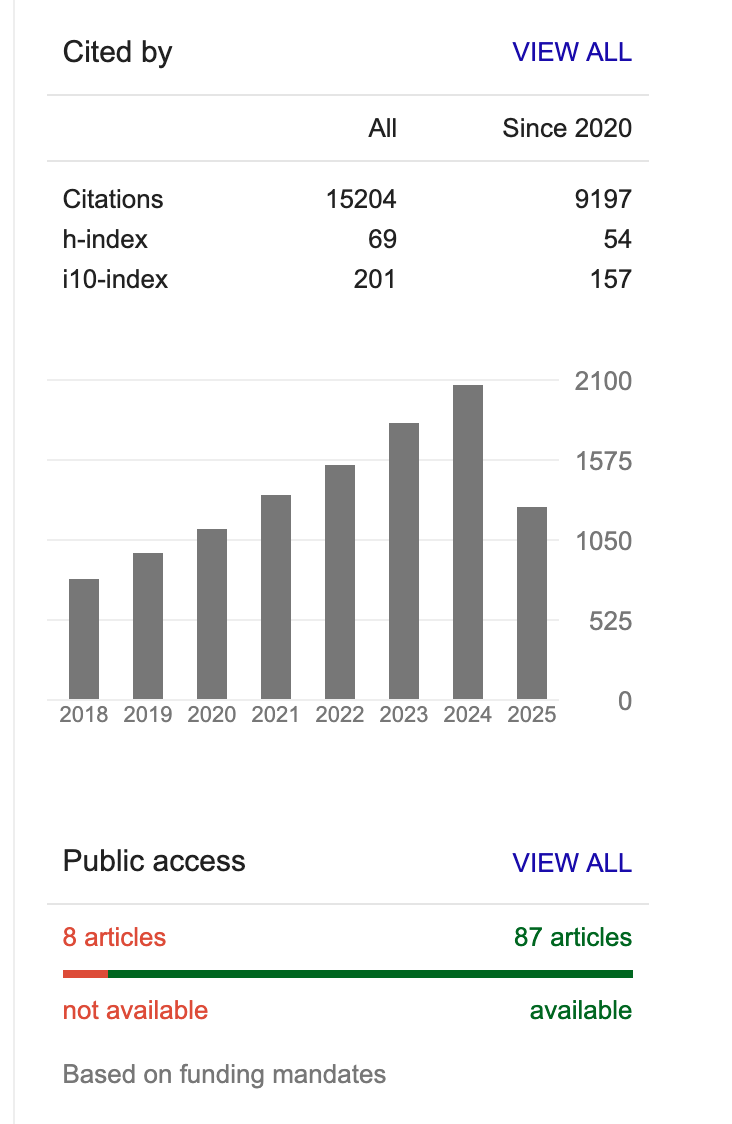
By the time it arrives in 2025 LAUSD PD, it’s not a model, it’s the model. We are not shown comparative data. We are not told “here’s one way to think about literacy acquisition, and here’s how it sits alongside others.” We are told, “this is what works”—as though the intervening five years had produced a mountain of empirical validation rather than a chain of self-reinforcing references.
And here’s the other part of the pipeline—policy and PD uptake don’t require evidence, they require authority. Teachers are structurally discouraged from questioning that authority. In my district, I’ve been told outright: PDs are “monologues, not dialogues.” That’s the phrase. Delivered to me after my early-career mistake of typing a challenge into the Zoom chat. I was a probationary teacher. I should “know my place.” I got the message. Everyone gets the message. You defer to the “expert.”
But I’m not the typical teacher. I came into teaching after a long career in forensic science, where you live and die by your ability to interrogate the evidence. I came in as a researcher myself. I came in AuDHD, which means my pattern recognition runs on default and my GLP mind hears the dissonance under the polished phrasing. I know how to follow a citation chain back to its foundations. I know how to ask: Who is saying this? Why are they saying it? Who paid for them to say it? Who’s missing from the picture?
And what I saw in Kim’s presentation was myth maintenance, not practical pedagogy. The slide titled “Executive Function” was a perfect example—grand heading, sparse mention in the actual 2020 paper, no actionable connection for the teacher in the room trying to get their i-Ready reading scores up. Meanwhile, any AuDHD person could tell you a great deal about executive functioning in real-life learners—because we live the consequences every day. But that knowledge is invisible here.
The result? Teachers leave the room with a beautiful European temple graphic, a tidy four-part hypothesis, and nothing they can actually use for the forty percent of students whose minds don’t fit the frame.
The Systemic Frame — How This Serves Capital
This is where the model shows its true function—not in the classroom, but in the marketplace. Capital loves a simple model. It loves the neatness of component skills stacked in sequence, each one measurable, each one testable. It loves the language of “struggling readers” because it presumes the default reader is an ALP, and anything else is broken. And broken things need fixing—preferably through a steady flow of interventions, programmes, and assessments that can be purchased, implemented, measured, and sold again when the results inevitably fall short.
In that framing, the forty percent of learners whose minds don’t follow the stair step to the top of that model—including GLPs, gestalt processors, and other pattern-first readers—are not simply unsupported; they are structurally invisibilised. Their needs aren’t written out of the curriculum by accident—they are omitted because recognising them would require dismantling the staircase altogether. That would mean abandoning the comfort of standardised benchmarks and the profit stream of remediation industries built on the idea of “deficits.”
You can see the same selective visibility in how autistic minds appear in popular media. The hyperlexic detective (Los Gringo Hunters / Patience), the savant accountant (The Accountant)—the kinds of characters who consume vast quantities of linear, textual data and spit out the one vital clue. These portrayals harmonise perfectly with the so-called “science of reading’s” norms because they stay within the ALP-compatible frame. They are an “acceptable” autism—brilliant, but only in ways the dominant literacy model can recognise. Pattern-first, meaning-first processing—the world where language arrives whole, living, contextual—rarely appears on screen except as a quirk, a deficit, a puzzle to be solved.
And the bitterest irony? We’ve known how to teach both ALPs and GLPs in the same room for more than a century. Vygotsky and his contemporaries laid that groundwork in the Soviet Union in the early twentieth century, showing that scaffolding—the original, uncurated Zone of Proximal Development—could flex to the learner’s way of knowing. But the version imported to the United States was stripped, curated, retooled for a system that needed compliant workers, not self-determined thinkers. The same process is at work here.
Kim’s model is not a bridge between literacy worlds—it’s a gate, and she’s the keeper. Not in the sense of personal malice, but in the function she serves: to preserve the dominant frame, to hold the door for those who fit, and to let the rest of us remain out of sight. The progress of struggling students—real, material progress that lifts the whole room—is not the point. The point is to keep the staircase standing, polished and intact, even if half the children never reach the top.
The Consequence — Erasing 40% of the Room
This is the cost of the staircase. U.S. reading scores don’t stagnate because children have mysteriously lost the will or ability to read—they stagnate because our frameworks have been built to fit only part of the room. The rest, the forty percent whose minds do not follow the linear, part-to-whole assembly line, are never given a map that resembles their own territory. The model Kim presented—and all its institutional cousins—charts a land that GLPs have never inhabited.
I see these learners every day. They’re not hypotheticals, not a line in a funding proposal—they’re in my classroom, in my caseload, sitting at desks with hands that trace meaning before phonics ever arrives. I know their maps because I’ve walked them myself. I know the landmarks, the shortcuts, the patterns that guide them toward language. And I know exactly how the official cartography erases them—not maliciously, but systematically, with every neat diagram that leaves no room for a path that bends.
It’s not as though no one has ever glimpsed their world. Blanc, Prizant, and others have been mapping it for decades through the lens of speech-language pathology. Their Natural Language Acquisition protocol, refined and supported by research like Blanc, Blackwell, & Elias (2023), offers a working bridge into GLP minds—a model for seeing pattern-first language development as coherent, rule-governed, and teachable. It is not the whole answer, because SLPs are trained to focus on speech, not literacy. But it is a door.
And that is what makes this erasure all the more unforgivable. The door is there. The work is easy to find—if you are looking. My own books and articles, written from inside both the classroom and the research library, are there too, pointing to what it takes to teach everyone in the same room, to make literacy something living and shared rather than a staircase to be climbed. But to look for this work is to admit the staircase might not be universal. And so the looking doesn’t happen.
The result is a quiet, chronic failure—not a collapse loud enough to force change, but a steady underperformance that can be blamed on the children themselves, on their homes, on their motivation. The forty percent remain unnamed, unmeasured, and unfed by the very systems meant to teach them. And the staircase remains, polished and inviolate, for those it was built to carry.
Closing Call: The Alternative Peer Review
So I come back to the questions that should have been asked, and weren’t. Where is the evidence? Who is missing from the frame? How would this model need to change—not just in wording, but in its bones—to serve the learners it has never even named?
And why Dr. Kim? No offence intended, but I could not trace her connection to my district. She didn’t share her slides, nor her contact information. Her public record shows twenty years of work in government-funded research, moving from grant to grant, project to project. I do not doubt her skill in that arena—but none of that is teaching my students, here, now. None of that is answering the forty percent who remain unacknowledged.
I have learned to carry my own map. I have learned that Kim’s is not the only cartography—nor the truest one for the whole room. There is a living ecology of literacy, one that begins whole: pattern, image, cadence, meaning, before any grain of skill is separated out. A map that does not ask you to climb step by step but invites you to move through the terrain you already inhabit, making sense as you go.
Until educators are trained to see that ecology and work within it, forty percent of the room will remain unseen—still there, still learning, still finding their way despite the official charts. And those of us who carry those other maps will keep walking them, will keep marking the paths, even when the district pretends they do not exist. Because we know they are real. We know they lead somewhere worth going.