
She, In Public
On misgendering, administrative truth, and narrative sovereignty

Born a human child, not a category. A ticked box became doctrine, echoed through every “sir” called across a car park. On clerical errors, tall womanhood, and the quiet act of amending the record in flesh and voice.
Opening — The Archive That Would Not Close
The first misreading of my life was administrative. It happened under fluorescent light, in the ordinary theatre of birth, when a body was observed and interpreted. That interpretation was recorded. The record hardened. The hardening was mistaken for truth.
But what interests me now is not the first entry. It is the persistence of the echo.
“Hey mister.”
“Excuse me, sir.”
These are not philosophical statements. They are reflexes. Social shorthand. Pattern recognition masquerading as knowledge. Height plus breadth plus decades of binary conditioning equals “he.” The algorithm runs in real time, in car parks and corridors and queues for coffee.
This is how classification sustains itself—not only through law or medicine, but through repetition. Each casual “sir” attempts to reinscribe the original ticked box. Not maliciously, most of the time. Simply obediently. The culture continuing its paperwork through the mouths of strangers.
Misgendering is often framed as confusion. I do not experience it that way. I experience it as enforcement. A gentle nudge back towards the archive. A reminder that the system still prefers its first draft.
And yet…
The system is not neutral. It never was. Birth certificates, diagnostic manuals, census forms—these are technologies of sorting. They do not discover essence. They stabilise expectation. They convert variance into categories that can be counted, managed, predicted.
I was tall before I transitioned. I am tall now. My shoulders did not widen when I claimed womanhood. My bones did not petition the state. What changed was authorship. What changed was who had interpretive authority over my interior life.
When strangers call me “sir,” they are not discovering something true about me. They are revealing the limits of their perceptual framework. They are demonstrating how tightly femininity has been tethered to smallness, to softness that does not occupy space, to proportions that reassure rather than unsettle.
A tall cis woman is “imposing.”
A tall trans woman is “misread.”
The body is the same scale. The narrative shifts.
I dress with intention. Not to hide. Not to apologise. But to remain legible within a profession that scrutinises women’s bodies relentlessly and trans women’s bodies doubly so. Elegance is strategy. Restraint is fluency. Function is survival.
And still—“sir.”
This is where the bruise lives. Not in doubt. Not in shame. In the friction between self-knowledge and social habit.
The question is not whether I was “born a man.” The question is who had the authority to name me, and why that naming was treated as immutable.
I was born a human child. A body observed. A category assigned. An interpretation elevated to ontology.
When I amended the record, I did not rewrite reality. I clarified it.
There is something quietly radical in that clarification. Not dramatic. Not theatrical. Just steady. She. Her. Pronouns that align with the grain of my own experience rather than against it.
The system prefers its first draft because it fears revision. Revision exposes contingency. Revision reveals that what was framed as destiny was, in fact, decision.
Each time I correct someone—softly, without spectacle—I participate in that revision. I remind the culture that clerical acts are not metaphysical truths.
I am tall. I am broad. I am a woman.
Not because I fit a silhouette.
Not because strangers approve.
Not because the archive consents.
But because I know who I am, and I have claimed the pen.
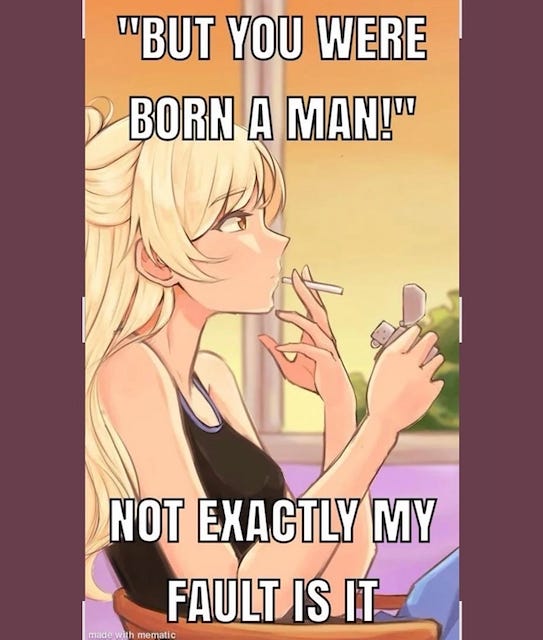
Clerical Error (Amendment Filed in Public)
I. The Clerk
I was not born a man.
I was born slick with breath
and unnamed in any way that mattered.
A body arrived.
Hands received it.
Eyes scanned.
Someone said, It’s a—
And the sentence closed around me
like a parenthesis.
Ink followed.
A box was ticked.
A future drafted in handwriting
I did not recognise as mine.
They call this origin.
They call this truth.
It was observation braided with culture,
sealed with administration.
Anatomy
plus expectation
equals assignment.
Assignment
repeated long enough
becomes fact.
Fact
defended
becomes doctrine.
But I was only a child.
Soft.
Unconsulted.
The first entry was made
without my voice.
II. The Call Across the Car Park
Decades later—
“Hey mister.”
The word travels before I do.
It lands between my shoulder blades.
“Excuse me, sir.”
Sir?!
Each he is a small rubber stamp
pressed into the day.
Not shouted.
Not cruel.
Casual.
Which is what makes it sting.
They are not speaking to my interior.
They are speaking to a silhouette.
To height.
To breadth.
To the training of their own eyes.
Pattern recognition,
mistaken for knowledge.
I feel it in the ribs—
a tightening,
a recalculation.
Do I correct?
Do I let it pass?
Do I swallow it for the sake of ease?
The ledger tries to update itself
through strangers’ mouths.
He.
He.
He.
A syllable can bruise.
III. Elegance as Armour
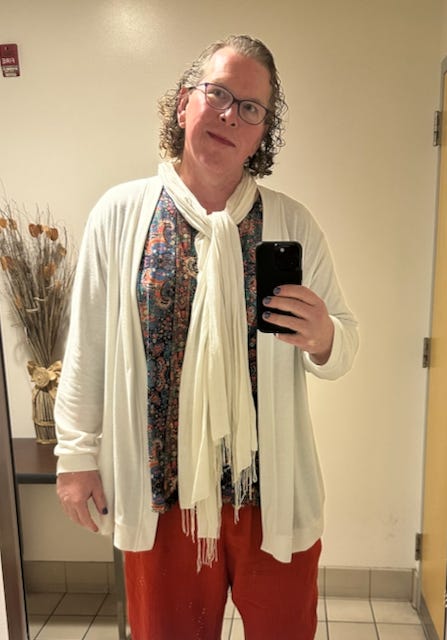
I do not dress in spectacle.
Cardigans.
Long lines.
Soft scarves that fall like quiet rivers
down the centre of my frame.
Tasteful.
As elegant as I can be
and still bend over a desk,
still reach the whiteboard,
still move between teenagers
without becoming a headline.
I downplay curves not from shame
but from literacy.
I know the classroom.
I know the gaze.
I know how easily a body like mine
is made into discussion.
So I choose restraint.
Function.
Structure.
Elegance as armour.
And still—
“Sir.”
As though femininity must be small
to be legible.
As though shoulders cannot belong to a woman
unless they apologise for existing.
They call to my proportions,
not to me.
They call to a heuristic.
To a shortcut.
To the old ticked box echoing.
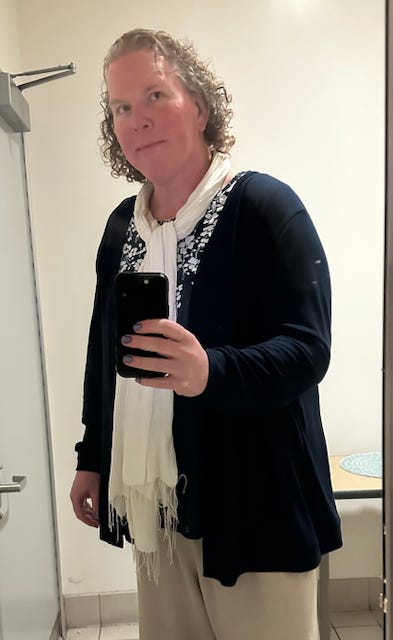
IV. Amendment Filed
I did not begin this story.
But I have edited it.
When given a pen,
I corrected the record.
Not as rebellion.
As alignment.
She.
Her.
Not costume.
Not fantasy.
Not denial.
Recognition.
The first inscription was clerical.
This one is lived.
I stand tall—
not because I am mistaken for a man,
but because I refuse to shrink
to make other people’s pattern recognition
feel correct.
“Hey mister.”
No.
I am not the error.
The error is the assumption
that a body can be summarised
by its outline.
The ledger was wrong.
I have filed the amendment
in flesh,
in fabric,
in voice,
in the quiet certainty
of calling myself by my own name.
And each time I do,
the bruise fades
a little faster.
Not specifically related to this article, but I really like that you use a picture of yourself as your profile picture now. It feels like ann important step.
Yesterday in your Sunday morning podcast, you were truly beautiful. Yes, from the inside out, like you always are, but visibly beautiful. It struck me from the moment the podcast began, and your smile felt like it came from a place where she lives comfortably. I was moved by that first, and then everything else, of course, but my very first impression was 'she is speaking to us.'