
Distributed Intimacy: Why Gestalt Love Doesn’t Narrow
On Objects, Companions, and Non-Exclusive Love

Gestalt love is field-wide, not hierarchical—friends, objects, animals, places held without competition. Not avoidance but abundance. A refusal of couple-centric scarcity in favour of distributed, resilient intimacy.
Introduction — Love Without a Centre
People often assume that when you speak of loving objects, animals, places, ideas, you are describing substitutions.
As if something went missing earlier.
As if this were compensation.
As if the heart were a room that failed to furnish itself “properly” and had to be filled with stand-ins.
That assumption has never matched my life.
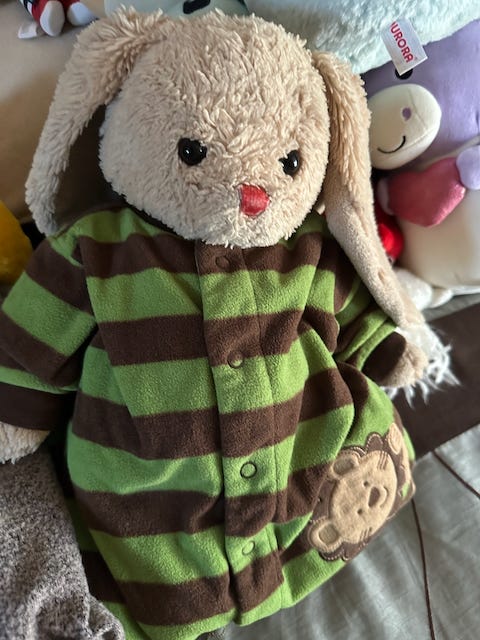
At the foot of my bed sits a small gathering. Plushies, yes—but that word does not quite hold what they are. Friends. Companions. Anchors. Continuities. Witnesses. They have travelled with me through decades, across houses and countries, through losses that were not survivable alone. They are not ranked. They do not compete. They simply remain.
This is not nostalgia.
It is not regression.
It is not an inability to attach “correctly.”
It is a different orientation to love.
Gestalt processors often love field-wide. Not because we fear depth, but because depth does not require narrowing. Affection does not arrive for us as a funnel or a hierarchy. It arrives as coherence—distributed, relational, sustained by many points of contact at once.
Friends.
Animals.
Objects that carry memory when language falters.
Places that hold the nervous system steady without asking to be chosen above all others.
Ideas that stay long enough to shape a life.
None of this replaces intimacy. It prevents it from collapsing under impossible demands.
The dominant culture insists on a centre: a couple, a primary bond, a singular container into which all meaning must be poured. Everything else is auxiliary. Decorative. At best, supportive; at worst, suspicious. Love, we are told, proves itself by narrowing.
But narrowing has always felt wrong in my body.
Not ideologically—somatically.
A tightening.
A thinning of the field.
The sense that something abundant is being asked to become scarce in order to be recognised.
When love is forced into a single channel, it becomes brittle. It asks too much of too few relationships. It demands that one person, one bond, one structure absorb everything else: history, regulation, continuity, future. That model fails many people, but it fails gestalt processors especially—because we are built to sense and sustain fields, not isolate threads.
This is where the misreading begins.
Plurality is interpreted as avoidance.
Non-exclusivity as fear.
Distributed attachment as dilution.
But what if it is accuracy?
What if loving widely is not a refusal of intimacy, but an ethical commitment to not overburden any one relationship with the work of being everything? What if field-love is not shallow, but resilient—able to hold rupture without annihilation, loss without collapse?
Objects matter here not because they are “safer than people,” but because they carry continuity without demand. They do not disappear when language fails. They do not require translation to stay. For a gestalt nervous system, this matters. It is not childish. It is infrastructural.
The same is true of animals, places, and ideas. They co-regulate without hierarchy. They participate in the field of a life without insisting on centre stage. They make it possible to remain attached without being consumed.
This is why I am writing this piece now.
After tracing gestalt as ethics, after naming what happens when the field collapses, after watching power learn to speak our language without meeting us there, it becomes necessary to talk about love—not as romance alone, but as orientation. As the way we distribute care, meaning, and belonging across a life.
This is not a rejection of romantic love. I have loved romantically. I love romantically. But romance has never replaced the field. It has always nested inside it. A bright node among others. Never the sun.
What unsettles people about this is not its strangeness. It is its sufficiency.
A form of love that does not beg to be legitimised. That does not collapse when one thread breaks. That does not require exclusivity to feel real. That survives not by hardening, but by widening.
The poem that follows does not argue for plurality. It lives inside it. It lets love appear where it already exists—in friends, in objects, in animals, in places, in the quiet competence of continuity.
This is not a defence.
It is a description of how I have always loved, and why it has never felt like lack.
Love, Without a Centre
They keep asking
who is first.
As if love were a queue.
As if affection had a spine
and everything else were decorative.
They want a centre of gravity
they can recognise.
A couple.
A bond that looks like a hinge
the rest of life swings from.
I never had that shape.
Love arrived for me
as environment.
Not one figure stepping forward,
but a field coming into focus.
Friends.
Animals.
Objects that held memory
when people could not.
Rooms that knew how to keep me.
Ideas that stayed
long after conversations ended.
Nothing competed.
Nothing needed ranking.
They told me this meant I was afraid.
That I was avoiding intimacy
by dispersing it.
That love only counted
if it narrowed.
But narrowing has never felt like safety to me.
It has felt like loss
arriving early.
I love the way a friend’s presence
changes the temperature of a room
even when we are not speaking.
I love the continuity of certain objects—
plush worn thin,
stones carried for years,
books that know when to fall open
to the right page.
I love animals
who do not require explanation
to stay.
I love places
that hold my nervous system steady
without asking me who I am to them.
None of this replaces anything.
It adds.
This is what they miss.
Plurality is not dilution.
It is density.
The field grows richer
the more points of connection
it can sustain.
They have been trained
to think of love as a funnel.
One body,
one future,
everything else peripheral.
So when they see my attachments,
they search for what must be missing.
They do not ask
what might be present instead.
For a gestalt mind,
love does not arrive in pairs.
It arrives as coherence.
As the felt rightness
of being held by many threads at once—
none of them strained,
none required to carry the whole.
This is not avoidance.
It is distribution.
I do not love less intensely
because I love widely.
I love more accurately.
No single relationship
is asked to contain
what a field can hold.
No one is burdened
with being everything.
This is why exclusivity
has always felt wrong in my body.
Not morally—
somatically.
A tightening.
A sense of collapse.
The field thinning to a corridor
I am expected to walk down
without looking sideways.
I have loved romantically.
I have loved deeply.
But even then,
love did not replace the field—
it nested inside it.
A bright node
among others.
Never the sun.
What threatens people
is not that this love is shallow.
It is that it is sufficient.
That it does not need
permission
or completion
or a narrative arc to justify itself.
That it does not ask to be chosen
over and over
to prove its worth.
They want love to be legible.
I want it to be livable.
I have grieved
when people left.
I have felt rupture.
But I have never felt
that love itself disappeared.
It redistributed.
It found other forms.
Other carriers.
Other ways to stay.
This is how I survived.
Not by hardening,
but by widening.
By letting affection take the shapes
it needed
instead of forcing it into one
that could fail me.
If this sounds dangerous,
it is only because scarcity
has been mistaken for depth.
Because we have been taught
that to love well
is to limit.
But I am not limited in my love.
I am held by it.
By friends.
By creatures.
By objects that remember me.
By ideas that keep unfolding.
By places that do not demand exclusivity
to offer shelter.
This is not a refusal of intimacy.
It is intimacy
without a choke point.
Love, for me,
has never been a contract.
And I have learned
how to live inside it
without asking it
to become smaller
so others can understand.