
Colonising Neurodivergence: Baron-Cohen, Autism, and the Politics of Assimilation
From “normal children” to deficit empires—how ARC’s amber-preserved logic still shapes policy, research, and the demand that autistic voices bend to the peer accent.

Baron-Cohen’s 1994 “accent study” wasn’t an outlier—it was a template. Autism framed as failure, fidelity mistaken for deficit. Three decades on, ARC still repeats the same tune. We refuse the peer accent—we remember, we resist.
Introduction: the Amber Specimen
Baron-Cohen, S., & Staunton, R. (1994). Do children with autism acquire the phonology of their peers? An examination of group identification through the window of bilingualism. First Language, 14(42-43), 241-248. https://doi.org/10.1177/014272379401404216
The 1994 Baron-Cohen and Staunton paper sits in my mind like an amber specimen—fossilised deficit framing, a relic and yet still alive, its assumptions pulsing through three decades of research that followed. I return to it often, not because it offers clarity, but because it reveals, in crystalline form, the worldview of Simon Baron-Cohen. The words themselves—“normal children”—tell me everything I need to know. They show me how autism was, and still is, conceptualised from his lofty academic perch: a condition defined against normality, a deviation measured in deficits, an object of perpetual fix. This, for me, is an evergreen study. It shows how deeply his thinking has been shaped by the conviction that autistic children fail where others succeed, that the refusal—or inability, in his framing—to adopt peer accents must stem from a broken drive to belong.
Yet I cannot read it without feeling the personal sting. I am a gestalt language processor who has not assimilated my dialect or my accent, and I have no plans to even try. The very suggestion that I should want to is insulting. The way I sound is not an error to be corrected but a loving remembrance of my ancestry and my grandmother, her voice still held within mine. It is the living echo of connection, not the absence of one. Much like the children in his study who sounded more like their nans than the children in the playground, my speech carries lineage, belonging, intimacy. Baron-Cohen never saw this—never allowed himself to imagine that fidelity to a mother’s or grandmother’s accent might be an expression of attachment, of love. His racist views of such things notwithstanding, he reduced the phenomenon to a deficit in social drive, a failure of assimilation, a refusal to normalise.
And from that amber-preserved stance, his Autism Research Centre has never really shifted. The blindspot around GLPs is not incidental—it is foundational. The pursuit of a fix, the relentless search for what is lacking, has structured ARC’s work for thirty years. This paper, then, is not just an old study—it is a history lesson, a story of a man who has tried to define autism for the world, armed with a framework that cannot comprehend us. It is also a reminder of how power works: how one researcher’s misunderstanding, amplified through volume, citation, and institutional backing, becomes the lens through which a generation is forced to see itself. This is how he thinks. This is what he thinks. And we live with the consequences.
The 1994 Hypothesis: Assimilation as Norm
The 1994 hypothesis reads to me like Rule Britannia come again, only this time its colony is autism. Accent retention was cast as failure, as if a child’s voice—rooted in the rhythms of mother or grandmother—were a problem to be corrected. The “normal drive to identify with peers” was assumed as universal law, an unspoken commandment: abandon the home tongue, abandon the family echo, assimilate into the dialect of the dominant group. To resist this drift was coded as lack. To hold on was to fail. And so autistic difference, already precarious under the psychiatric gaze, was reinterpreted through the same lens that once policed colonised bodies—our voices recast as insubordinate, unserious, in need of discipline.
That such a study could be conceived at all reveals the imperial mindset still woven through British medicine and psychology, long after the empire itself had collapsed. The empire might have relinquished its territories, but not its habits of mind. For Baron-Cohen, the autistic child who retained their mother’s accent was not a subject worthy of curiosity or respect, but a little rebel refusing to bend to the “natural” order of peer assimilation. The framing is not neutral—it is steeped in the colonial conviction that those who resist assimilation must be brought to heel. It echoes the tone of an empire that viewed any difference, any refusal, as dangerous.
In this light, his research begins to look less like the detached pursuit of knowledge and more like a continuation of imperial policing by other means. Autism becomes the territory to be surveyed and subdued. Accent becomes a mark of allegiance. Retaining the wrong one is a threat. This is the same mindset that celebrated Churchill whilst he starved the Bengali—difference treated as disobedience, and disobedience punished with erasure. Baron-Cohen’s “normal children” were never just a control group; they were the imagined citizens of empire, the standard against which all others are diminished.
To me, the cruelty lies not only in the misinterpretation of gestalt processing, not only in the blindness to how autistic children actually hold language, but in the deeper truth revealed here: that Western medicine has carried forward the coloniser’s logic into its dealings with neurodivergence. These wee buggers must be made to heel, to speak with the right accent, to prove their loyalty through assimilation. In this schema, the autistic voice is not allowed to be its own—it must be broken, redirected, normalised. This is not science; it is conquest by another name.
What They Missed: GLP as the Unnamed Presence
What they missed in 1994 was not subtle—it was staring them in the face. Eighty-three per cent of autistic children in their study retained their mother’s accent, a finding they cast as failure to assimilate. But to anyone who understands gestalt language processing, this is not failure at all—it is exactly what one would expect when children hold their language as intact scripts. The fidelity to accent, intonation, even rhythm, is part of the gestalt itself. Breaking it apart to approximate the peer dialect isn’t possible until later developmental stages, if ever. What Baron-Cohen read as deficit was in fact fidelity.

And here’s the galling part: this was already visible in the field. By the mid-80s Prizant was writing about echolalia in developmental terms, Peters before him on formulaic speech. The literature existed. Yet when you search today—“Baron-Cohen” and “gestalt language processing”—you get a mere handful of hits, none authored by him. Not one. Eighteen results, all of them citing him in passing, none by his own hand. He has never written on GLP, never grappled with autistic language use as it actually is. And yet he presumes the role of authority, the man who defines autism for the world from Cambridge.
This is the absurdity I cannot escape. He has no expertise in autistic language, no curiosity about gestalt processing, and still he builds his empire on pronouncing what autistic communication means. He cannot hear what we are saying, and he has not tried. The “mother’s accent” finding was a door left wide open, and he closed it before stepping through, because it didn’t fit his deficit frame. That blindspot has hardened into institution: the Autism Research Centre continues to orbit around theory-of-mind, empathy deficits, extreme male brain. The gestalt voice remains unnamed, unrecognised, because to acknowledge it would unravel the whole edifice.
FFS!—he has never written a paper on GLP, and yet his name dominates the autism literature as if he were an authority on everything. What does it say about the field, that the man most responsible for defining autism cannot hear how we actually speak?
The ARC Through-Line
The through-line of the Autism Research Centre is one of astonishing consistency—astonishing, and horrifying. From mindblindness in the 1980s and 90s, to the “empathy deficit” and “extreme male brain” formulations of the 2000s, to the endless churn of empathising–systemising questionnaires, Simon Baron-Cohen has never left his starting position. Autism is framed as lack, as failure, as deviation from the neurotypical norm. His 1994 accent paper was not an oddity—it was the blueprint. In that paper, children who sounded like their mothers or grandmothers were marked as deficient, their voices cast as evidence of failed socialisation. And in the decades since, every new iteration has followed the same pattern: find an autistic trait, strip it of context, declare it a deficit.
The man is prolific beyond belief. Over 750 peer-reviewed papers carry his name—an academic empire sprawling across autism, cognitive sex differences, prenatal hormone theory, synaesthesia. It’s not simply publication, it’s architecture: scaffolding that has defined what governments, universities, and policymakers think autism is. His influence is not marginal; it is hegemonic. If you search Scholar, if you skim an LLM-synthesised literature review, Baron-Cohen will be there, cited endlessly, shaping the very epistemic terrain. And yet—and this is the heart of it—his theories are reviled by the very people they claim to describe. Within autistic communities, his name is synonymous with pathologisation, assimilation, and erasure.
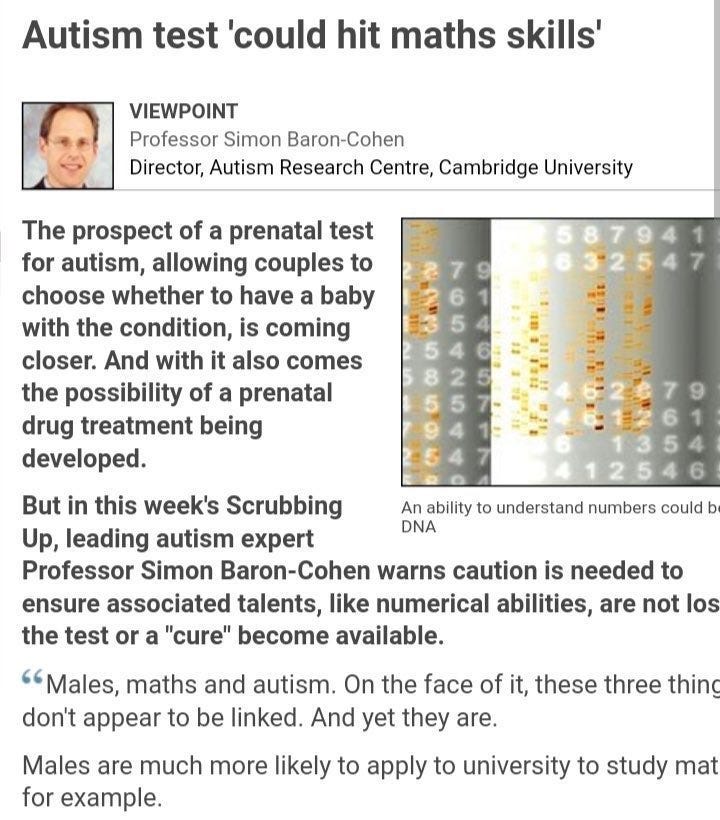
The above image attached says it all. “Autism test ‘could hit maths skills’.” The vile calculation laid bare: we cannot fully eliminate autistic people (though the prospect of prenatal testing, selective abortion, and drug treatments are openly welcomed), because who then will do the maths? What remains is the instrumental tolerance of our existence—we are to be kept around so long as we provide utility to the empire of numbers, and even that is framed as caution rather than celebration. The internet doesn’t forget. Nor should we.
And so the question becomes historical as well as personal: where else has one “expert” held such sway over the framing of a population, while being so loathed by that population itself? The closest analogues lie not in medicine’s celebrated reformers but in colonial administrators, phrenologists, eugenicists—those whose scholarship was adored by governments and elites because it gave intellectual cover to control. Baron-Cohen is feted with medals, Cambridge titles, Millennium awards. He is the darling of policy, precisely because his theories align with what power requires: a view of autistic people as defective citizens, in need of intervention, tolerable only so far as we serve national utility.
The ARC’s through-line is thus not an academic quirk but a political instrument. It has built, paper by paper, a fortress of deficit framing, protecting institutions from the truth of autistic life. And here lies the bitter irony: never has there been an “expert” so widely celebrated by the ruling class, and so utterly disavowed by those whose lives he claims to define.
The Politics of Assimilation
Assimilation is never innocent—it is a demand for belonging enforced through national and linguistic norms. In the 1994 accent study, Simon Baron-Cohen framed autistic children’s retention of their mother’s accent not as attachment or identity, but as failure—a deficit, proof of a supposed inability to conform to peer identity. Assimilation was treated as virtue, belonging defined by mimicry of the dominant, the unmarked, the standard. You sound like your mam, not the playground—there must be something wrong with you.
Now place this against the work of Isaac Eyi Ngulube, a Nigerian professor of English language and linguistics. His book Learn English Son is not concerned with erasing accents or demanding assimilation. Instead, it explores language as culture, inheritance, and clarity. Having taught in Nigeria, Britain, and the US, he approaches English with the eye of someone rooted in a country that has lived under colonial language policy and yet made English its own. Nigeria is a place where over five hundred languages coexist, where Nigerian Pidgin and Nigerian Standard English carry the rhythms of many tongues, and where oral traditions hold memory through song and story. To write about English from such a place is to understand language not as a uniform code to be imposed, but as a living thing, layered and multiple.
Seen through this lens, the autistic child who retains their grandmother’s accent is not failing at socialisation. They are keeping love alive, carrying memory in their voice, sustaining stability through sound. This is what Ngulube captures—language as inheritance and belonging. Gestalt language processing fits naturally within this frame: language as script, as whole, as embodied memory, not something to be broken into atomised parts for the convenience of assimilation.
Baron-Cohen’s work, by contrast, casts language difference as defect. The Autism Research Centre has consistently reinforced assimilationist expectations: the “normal” is left unmarked, assumed, whilst the autistic or foreign voice is othered and pathologised. This is not science in any neutral sense—it is the reproduction of colonial logic in the study of autism. And the harm is intimate: every autistic child told they must bend their voice to fit a world that has no intention of listening.
Why This Matters Now
Why this matters now is that the same deficit framework, preserved in amber in 1994, is still the first thing you find when you go looking. With the rise of LLM-driven research tools, Simon Baron-Cohen continues to dominate the citation space. Search “autism” in Scholar, Consensus, or Gemini, and his name spills across the page, not because his work is especially insightful, but because he has published more than seven hundred and fifty articles, each one building upon and reinforcing the same assumptions. Volume is mistaken for authority, and authority becomes canon. The result is that what rises to the top of search is not diversity of thought, not autistic voices, but the same old deficit model, endlessly recycled.
Because the Autism Research Centre has not shifted its stance, those early frames still shape the knowledge environment: autism as mindblindness, as empathy deficit, as failed assimilation. This isn’t just an academic quirk. These framings filter outward, informing public policy, shaping diagnostic criteria, guiding intervention models, and seeping into everyday prejudice. Parents hear it when professionals tell them their child “lacks” theory of mind. Teachers hear it when training frames autistic communication as “inflexible.” Autistic people hear it in every conversation where our ways of speaking, remembering, or belonging are recast as disorder. The weight of one man’s empire of deficit becomes the background noise of culture, echoing until it sounds like truth.
This is why returning to the 1994 study matters—not because it was right, but because it set the pattern. Thirty years later, the same logic governs the searches, the policies, the interventions. In the age of AI, where citation volume sets the terms of knowledge, deficit thinking isn’t fading into the archive. It’s being amplified, automated, and redeployed. And autistic people are left to live in the shadow of a narrative we never consented to, a narrative that still insists our voices should not sound like our own.
Conclusion: Refusing the Peer Accent
What Baron-Cohen and his colleagues once marked as pathology is precisely where I locate strength. The children who spoke with their mothers’ or grandmothers’ accents were not failing to assimilate—they were remembering. They were carrying love and lineage in their voices, holding fidelity to scripts that meant belonging, not estrangement. In his framework, this was deficit, a lack of the “normal drive” to fit in with peers. But in truth, it is refusal—an autistic refusal of assimilation, a quiet act of preservation.
I know this in my own life. I am an AuDHD gestalt language processor who has never assimilated my dialect, never reshaped my accent into something more palatable, and I have no plans to. To suggest that I should want to is insulting. The way I sound is not broken—it is a remembrance of my grandmother, a continuity I choose to honour each time I speak. When I write about the absurdity of being forced to transcribe into “West Coast IPA” for my credentialing programme, what I am describing is the same dynamic. I was told there was one correct way to code sounds, and it wasn’t mine. To refuse that imposition was not failure but fidelity—to my own scripts, my own cadence, my own belonging.
This is what must be reclaimed. Accent retention, dialect fidelity, refusal to transcribe into someone else’s code—these are not defects to be corrected but acts of resistance, of holding ourselves intact against the flattening demands of assimilation. Baron-Cohen’s 1994 melody is still being replayed across the autism canon: the insistence that we must bend, shift, conform to prove our humanity. But we do not need another repetition of that score. What we need is a new canon—one that hears autistic voices in their own timbre, one that honours fidelity as belonging, and one that understands refusal not as deficit, but as the most powerful form of survival.
Thank you for this piece. It is clear to me that SBC's "work" is firmly rooted in white supremacy. I will never forget reading in Sheffer's book that his mentor and co-author Uta Frith translated Asperger's 1944 treatise in a way that "softened" the historical context of his work and completely left out the preface, which made 100% clear his intellectual adherence to the Nazis and the Third Reich. I also remember seeing the roots of the SBC's "extreme male brain" idea in Asperger's thinking.