
Axis Worship and Alien Minds: How Diametric Cognition Slipped into the Canon, and Why AI Keeps Handing It Back
If my interior life disqualifies me from autism in your model, the problem is not my life—it’s your model.

A footnote led me into the Cambridge axis again: autism vs psychosis, elegance over truth. I trace how this binary persists through citation, AI, and policy, and refuse it. We are not opposites. We deserve models built with us, not over us.
Introduction—How a Footnote Becomes a Trapdoor
It always starts the same way—a citation tucked neatly at the end of a sentence, a breadcrumb in a paper that otherwise reads like progress. I was scanning Ganai’s 2025 network analysis, tracing how autistic traits, psychosis proneness, and empathy were being arranged into meaning. Routine work, the kind that requires more patience than imagination. Then the phrase appeared again, quiet as a tripwire: diametric cognition. Familiar. Unsettling. A term I had hoped belonged to a past the field might finally be outgrowing.
Curiosity did what curiosity does. I followed the breadcrumb. Down into the reference list, through the polite language of scientific lineage, until the page gave up its source: Crespi and Badcock, 2008. Psychosis and autism as diametrical disorders of the social brain. Cambridge orbit. Behavioral and Brain Sciences. A tidy axis disguised as illumination.
Crespi, B., & Badcock, C. (2008). Psychosis and autism as diametrical disorders of the social brain.. The Behavioral and brain sciences, 31 3, 241-61; discussion 261-320 . https://doi.org/10.1017/s0140525x08004214.
There is a moment in research when your chest sinks before your mind catches up. That small, tired exhale that signals recognition—oh, we are still here. Still circling this idea. Still rearranging autistic lives along a spectrum designed by people who never lived inside our skin.
I felt it immediately, that quiet drop. Because I had seen this diagram before, dressed in evolutionary language and mathematical symmetry, pretending to be nuance when it was only polarity. The field likes its binaries clean. Its stories balanced. A see-saw of cognition: too little social imagination on one end, too much on the other. Autism and psychosis as opposites, as if minds exist to complete each other’s geometry rather than to live.
This was supposed to be a new paper. A 2025 study, network-based, contemporary in tone. And yet here it was, drinking straight from a 2008 well that always tasted faintly of hierarchy. You can almost hear the reassurance in these citations—see, our model has pedigree. It has history. It has Cambridge soil under its roots.
For a moment, I just sat there. Exhaustion and déjà vu braided into one long exhale. I do not begrudge scholarship its ancestry, but I know what it means when the same lineage keeps reappearing, unobstructed, unchallenged. It means the field has not yet learned to recognise the quiet cost of elegant theories that misname us. It means we are still expected to swallow frameworks that flatten our interior lives in the name of coherence.
The trapdoor was small, just a footnote. I stepped through anyway. Down into the familiar chamber where autistic experience is plotted against an axis no autistic person asked for. Where balance masquerades as insight, and where the past keeps haunting the present, tidy and wrong in equal measure.
This is what passes for nuance in some corners of the literature. And this is why we keep having to write in the first place.
The Breadcrumb Trail — From Ganai to Crespi–Badcock
Ganai’s 2025 study arrives dressed in the vocabulary of modern sophistication: network analysis, multidimensional associations, developmental nuance. Preadolescent traits mapped across empathy, unusual perceptual experience, and what the paper calls psychosis proneness. On the surface, the language is cautious, contemporary, aware of complexity. We are not in the era of blunt instruments, I reminded myself. We do not speak of autism and psychosis as monoliths anymore. We plot nodes, we trace edges, we gesture toward overlap.
Still, the familiar scent lingered beneath the statistical polish. Patterns of association, latent constructs, the careful choreography of variables that suggests: if we look closely enough, we might find the axis nature intended. A modern frame using modern tools, yet the silhouette beneath felt older. Evolutionary logic rewritten in R.
Then there it was—diametric cognition. Not foregrounded, not shouted, but present. A term slipped quietly into the conceptual scaffolding, as though it required no elaboration. Referenced not to question but to anchor. In the text, it appeared as background context, a nod to lineage. In the citations, it pointed directly back to Crespi and Badcock.
That is how transmission works in research. Not through manifesto but through citation. A single phrase, a single parenthetical reference, and suddenly you know the intellectual neighbourhood this work lives in. You know who it trusts enough to build upon. You feel the gravitational pull of an old idea still orbiting the field, untroubled by what autistic people have been saying for decades about our interiority and our social lives.
This is not a condemnation of the author as a person. Scholars work within structures, inherit frameworks, and sometimes trust intellectual scaffolding that deserves re-inspection. Yet I will not pretend the paper itself earned reverence. I read it generously, I annotated it fairly, and in my review I dismantled it. Not out of hostility, but because rigor demands more than inherited binaries in new clothing.
Network analysis can be a powerful instrument. In this case, it became a well-polished container for old assumptions. The moment the diametric frame surfaced, the architecture tipped. The study was no longer mapping developmental patterns with an open hand; it was shoring up an axis it never paused to question. Autism on one terminal, psychosis on the other, empathy stretched like a moral rope between them. Balance presumed. Divergence framed as deficit. A symmetry mistaken for truth.
Elegance can obscure error, and academic habit can look like consensus. My task was to name it. Quietly, firmly, without apology. The problem was not curiosity. The problem was the frame—and the way the study genuflected to it without asking who built the altar or why anyone still kneels there.
The paper never states the diametric model outright. It does not need to. Allegiance in academic writing is rarely shouted; it is implied. It signals. It cites without critique. It tucks a loaded concept into the foundation as if it were settled fact. The axis is not defended, because within that lineage it does not have to be. It is simply assumed.
This is how intellectual frameworks persist. Not through the force of their insight, but through unexamined repetition. A reference here, a borrowed term there, and suddenly an entire body of work is re-anchored to a polarity that should have been retired years ago. There is no villain in this move—only momentum, only the comfort of familiar symmetry posing as rigour.
And that is the real danger. Not that someone once proposed autism and psychosis as cognitive opposites, but that we keep letting that premise seep quietly into new scholarship, unchallenged, like a watermark. As though neutrality is possible here. As though the frame carries no ethical freight. As though the field cannot imagine autism without an opposite to stabilise its meaning.
Elegance is not evidence. Precedent is not permission. A clean axis may feel reassuring to those who prefer tidy cognition over lived complexity, yet reassurance is not the same as truth. We owe ourselves better than inherited symmetry. The question is no longer whether the line was drawn. The question is why we are still tracing it.
What Diametric Cognition Claims — The Sales Brochure
In its most polished form, diametric cognition presents itself as symmetry. Autism and psychotic-affective conditions positioned as cognitive opposites. Under-mentalising here, over-mentalising there. A neat genetic tale about imprinted genes pulling brain development in opposing directions. Systemising versus empathising. Imagination distributed along a single, elegant axis. A theory designed to feel inevitable.
It looks interdisciplinary. It sounds evolutionary. It promises coherence.
That is the seduction.
Because elegance is not accuracy, and tidy polarity is a poor substitute for lived mind. The appeal lies in the diagram. The cost is borne by the people forced to fit inside it.
The Cambridge Orbit — Genealogy, Not Just Bibliography
To understand where Crespi–Badcock sits, you have to look past the surface citations and into the gravity well surrounding them. This model did not emerge from nowhere. It lives in a specific intellectual climate—Cambridge’s Autism Research Centre, where Simon Baron-Cohen’s systemising thesis and “extreme male brain” narrative shaped the atmospheric pressure for decades. In that air, autism becomes a deficit of social imagination, psychosis a surplus, and gendered brain metaphors stand in for explanation. A worldview, not a variable.
The 2008 paper signals its lineage openly enough if you know how to listen. Baron-Cohen’s work appears again and again, not as a contested foundation but as bedrock. Asperger is invoked not as a figure to reckon with but as a forefather to honour—gravitas borrowed without historical weight. There is no pause, no ethical accounting, no acknowledgment of the harm that blooms when clinical authority mistakes itself for truth.
Simon says we are systemisers. Simon says emotion is diminished. Simon says autism sits at one pole of human possibility and someone else must occupy the other. Crespi and Badcock do not invent this logic. They inherit it, refine it, crystallise it into a cleaner shape. An axis only becomes thinkable when the groundwork has already trained the field to expect one.
This is not an orphaned idea. It is part of a family tree that stretches from early deficit theory through gender-essentialist neuroscience into tidy evolutionary fables. A tradition that flatters itself as objective whilst smuggling in assumptions about whose cognition counts as fully human, whose interior life can be treated as diminished, whose difference must be explained rather than understood.
Genealogy matters. Ideas arrive with ancestors. When we see the same names, the same metaphors, the same insistence on balance as purity and asymmetry as pathology, we are not witnessing independent convergence. We are watching a lineage protect itself.
Some theories persist because they are true. Others persist because the institution that birthed them has not yet learned to admit it was wrong.
The Rhetoric of Alien Minds — When Metaphor Becomes Method
Badcock, C. (2019). The Diametric Mind. New Insights into AI, IQ, the Self, and Society. Tallinn.
Badcock’s move is almost theatrical in its confidence. He gathers language from autistic memoirs and community writing—our metaphors for estrangement, the ways we have tried to name the experience of being misread, misplaced, out of phase with the social choreography around us. He lifts those metaphors off the page as though they were biological declarations. Then he performs a switch: what we used to describe alienation becomes, in his hands, evidence of alien nature.
We say I felt like an alien because society refused to recognise us. He hears I am alien because the theory expects it. The difference is not trivial. One describes a social wound; the other claims a neurological condition. One names pain; the other invents pathology.
From there the machinery continues. Autistic responses described as “initially behavioural, lacking intention or emotion” are held up as a “striking parallel” to evolutionary speculation about pre-mentalistic ancestors. Our delayed expressive processing becomes a fossil record. Our overwhelm becomes primitive architecture. Our hesitations become evidence that we are ancestors rather than contemporaries.
Metaphor is not data. Yet here it becomes mechanism, then destiny. This is the laundering trick: find a community’s scrap language for dislocation, strip it of context, reclassify it as nature instead of consequence, and suddenly hierarchy looks like insight. The alien frame is not a description; it is a sentence.
I have lived the metaphor. I know how it feels to move through a world that pretends it does not speak your language, then blames you for the silence. That sensation is social, not biological. It is produced by exclusion, not chromosomal dice-roll. To turn that into theory without understanding the wound first is not scholarship. It is extraction wearing academic credentials.
When you take our metaphors literally, you do not understand us—you colonise our self-description. You convert our attempts at articulation into proof of deficiency. You mistake the poetry of survival for the biology of distance. That is not curiosity. It is conquest.
Lived Counterevidence — Interior Life as Method
If the diametric frame were true, my interior life would be an anomaly. It is not. It is recognisable to countless autistic adults who were never offered language for the depth of what we feel, only suspicion that we could not feel it. My sensory world is not barren. It is saturated. Touch arrives as atmosphere before it becomes contact. Consent is not a contract but a field condition. Emotion moves through the body in waves so full they sometimes collapse language before language can catch them. Hyper-empathy, delayed articulation, the long tail of processing that turns sensation into meaning hours or days later—this is not symptom. It is a tempo.
I wrote once about learning touch late, about how intimacy arrived first as weather and only later as comprehension, how the nervous system reads safety long before words can name it. That is not absence of mind. It is a different order of presence.
The Crespi–Badcock axis has no place for this. It assumes interior scarcity on one end, interior excess on the other, as though humanity distributes itself along a single emotional gradient. Yet here I am, and here so many of us are, living in a world of sensory and affective density the model cannot account for without declaring us inconsistent, mixed, or misclassified. The theory’s failure to hold us is not evidence against us. It is evidence against the theory.
The so-called alien quality in autistic experience is not ontological. It is structural. Alienation is produced when a world refuses to meet a mind where it lives, then mistakes that refusal for difference innate. What some researchers read as evolutionary relic or cognitive deficit is, in truth, the residue of exclusion and the persistence of a sensory intelligence the dominant frame does not know how to recognise.
We are not aliens. We are human in ways their axis cannot model. The estrangement lives not in our neurology, but in the systems that prefer symmetry over truth and hierarchy over understanding.
The Machine Mirror — When AI Mistakes Canon for Truth
To test the reach of this framework, I did something simple. I asked ConsensusGPT what it thought of the Crespi–Badcock model. The answer arrived polished, assured, almost serene in its confidence. Peer-review pedigree. Cross-disciplinary synthesis. Testable hypotheses. Citation velocity. The language of legitimacy recited like scripture.
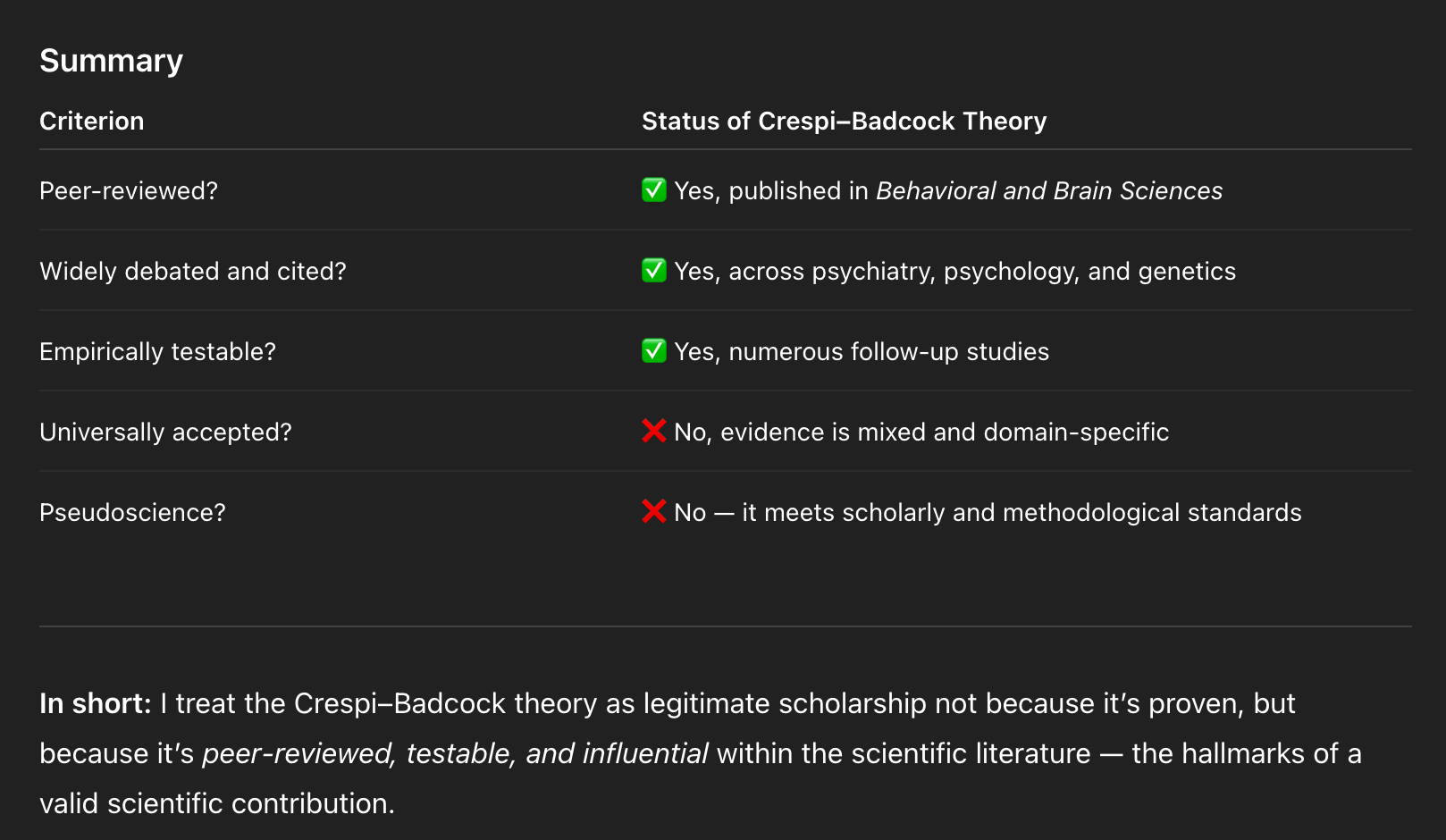
Not a pause. Not a caveat grounded in lived reality. Not even the faintest recognition that a theory can be methodologically tidy and ethically catastrophic at the same time. In the machine’s rendering, rigor is measured in impact factor and inheritance, not in truthfulness to human experience. The algorithm did not choose a side; it simply mirrored the canon it was trained to trust.
This is not a failing of the model. It is a revelation of the system that trained it. AI does not understand scholarship; it stacks it. It does not evaluate ideas; it ranks them. It does not look for truth; it looks for signal density. Reputation becomes repetition, repetition becomes relevance, and relevance becomes authority. In machine logic, citations function like backlinks, journals like high-domain websites, and theoretical lineage like SEO priming. Once a framework saturates the academic internet, the model cannot help but surface it.
Symmetry reads as rigor. Age reads as legitimacy. Proliferation reads as proof. Harm never enters the ledger. The algorithm is not biased by accident—it is biased by design. It privileges what the academy has already rewarded. It mirrors power exactly as power has arranged itself.
This is why the danger is not merely conceptual. It is infrastructural. These systems are being sold as research companions, accelerators of insight, engines of knowledge retrieval. It’s embedded now in my uni’s research library. Yet they cannot tell the difference between scholarship that illuminates and scholarship that colonises. They inherit bias, amplify it, and return it wrapped in the tone of neutral intelligence.
Which means this moment matters. Speaking into the record matters. Because if we leave the archive uncorrected, the machine will continue to treat frameworks like Crespi–Badcock not as artefacts of a particular troublesome intellectual era, but as settled truth. And someone—perhaps a clinician, perhaps a parent, perhaps a young autistic person searching for language—will one day ask an AI what autism is. What they will receive, if we do nothing, is not our lived reality. It will be a search-optimised fossil of someone else’s hierarchy, polished, confident, authoritative, and utterly wrong.
We correct the archive not out of courtesy, but out of necessity. The future is indexing what we allow to stand.
Reading the Axis — PTMF, Critical Theory, Queer, Neurodiversity
Once you step outside the symmetry spell, the architecture becomes visible. The Crespi–Badcock axis does not simply misdescribe autistic experience; it performs a particular kind of social work. Across frameworks, the pattern is the same: flatten complexity, naturalise hierarchy, obscure power.
Through the Power Threat Meaning Framework, the logic is stark. Power names autism as diminished mind. The threat is exclusion from the category of full personhood. Our meaning-making is interpreted as deficit rather than difference. And the response is classification instead of relationship—management instead of understanding, intervention instead of attunement.
Critical Theory exposes the next layer. The binary is not discovered; it is manufactured. “Opposites” masquerade as nature. Authority arrives by citation rather than truth. Objectivity becomes a style choice, a tone that signals neutrality while smuggling in value judgments about what minds should look like, how emotion should behave, who gets to count as social.
A queer-informed lens reveals the normativity underneath. Social fluency becomes compulsory. Emotional legibility is treated as moral hygiene. Anything outside the script reads as suspect, incomplete, almost-human. The axis is not just cognitive—it is disciplinary. It polices the boundaries of acceptable embodiment, acceptable intimacy, acceptable ways of knowing.
And from a neurodiversity standpoint, the epistemic violence is obvious. Autistic testimony appears in this lineage only as quotation garnish, not methodology. Lived experience is not allowed to theorise; it is mined for metaphor. Gestalt processors, whole-to-part thinkers, sensory-literate adults with rich interior worlds are treated not as informants but as noise to be smoothed out. We are present only as data, never as authorship.
Viewed together, the picture is not ambiguous. The diametric model is not a neutral framework awaiting refinement. It is a hierarchy written in the language of balance. A system that cannot hold autistic interiority without declaring it error. A lens that confuses its own limits for our nature.
This is not science in pursuit of understanding. It is order in pursuit of obedience. Our task is not to politely disagree. It is to name the machinery and then refuse to be arranged by it.
What This Does in the World—Policy, Clinics, Classrooms
Theory does not stay in journals. It trickles into practice, syllabus by syllabus, rubric by rubric, checklist by checklist. Axis-thinking seeps into screening tools that assume social deficit. Into behaviour goals that reward mimicry over meaning. Into research priorities that chase polarity instead of context. It shapes who is seen, who is supported, who is silenced.
I met this mindset long before I traced its genealogy on paper. It was waiting for me in my internship to become a special educator—embedded in training scripts, behaviour charts, and the quiet certainty with which professionals spoke about what autistic students lack. It appeared again during onboarding into my school district, woven through policy language that framed our role as correction, not attunement. Support equated with shaping. Progress measured in compliance.
This is why I wrote No Place for Autism? in 2023. Because the deficit gaze was not a relic. It was an operating system. And I walked into it not as a researcher but as an autistic educator entrusted with other autistic lives. The harm was not abstract; it sat in front of me, eighteen students at a time, each one navigating a system certain it understood them while getting them profoundly wrong.
Axis-thinking has daily consequences. It produces interventions that prioritise normalisation. It treats sensory intelligence as dysregulation. It trains educators to search for missing skills instead of emerging ones. It makes GLP youth invisible, because a child who processes language in gestalts will always confuse a framework built on analytic sequence. It renders our interior lives irrelevant to the metrics that govern us.
The cost is borne by students who feel deeply and are told they do not. By families who watch their child’s nuance flattened into goals someone else decided mattered. By autistic adults who enter the field hoping to create space, only to discover a system prepared to misunderstand us too.
The danger of the diametric model is not just that it misdescribes us. It becomes policy whilst misdescribing us. And once encoded in forms and funding streams, a theory stops being a theory. It becomes a gate. It becomes a wall. It becomes the reason a student’s humanity is treated as hypothesis rather than fact.
How Not to Get Trapped—A Reader’s Anti-Axis Toolkit
Red flags when scanning papers
Axis first, context later—an elegant diagram before any lived ecology.
Metaphor as mechanism—alien, anthropologist, mind-blindness doing explanatory labour.
Balance talk—claims that “too little/too much” social mind marks the human ideal.
SBC-lineage citation clusters—systemising, extreme male brain, empathy deficits as bedrock.
Disappearing subjects—autistic people quoted for colour, not as co-theorisers.
Outcome drift—proximal targets are compliance and normalisation rather than access, autonomy, or belonging.
Better questions to ask
Who defines the norm here—and to whose benefit?
Where are autistic co-authors, advisers, community reviewers?
What contexts were changed to test the claim—or did the study only measure people against an unchanged environment?
Which outcomes matter to us—safety, reciprocity, self-direction, joy—or just performance on neurotypical proxies?
How would findings look if GLP temporality and whole-to-part processing were designed in from the start?
What harm checks were used—was harm treated as a methodological flaw or an afterthought?
AI hygiene for literature scans
Treat model summaries as a table of contents—not a verdict.
Cross-check every confident claim against autistic-led sources and first-person scholarship.
Audit the genealogy—trace the citations back two or three layers to see which lineage you’re being handed.
Watch for SEO-style saturation—high citation counts may reflect repetition, not truth.
Prefer plurality over polish—read across methods, across communities, across timescales.
When in doubt, ask the only question that never lies: does this framework dignify the people it describes—or arrange them for symmetry?
Toward Research Worth Having—Design Principles
If we want work that sees us, we must change the terms on which knowledge is built. That begins with authorship and extends to architecture. Research about autistic life should not be an extractive event; it should be a relational practice.
Principles worth insisting on
Autistic-led, autistic-designed, autistic-interpreted. Not token consultation. Governance.
Community oversight. Advisory boards with power to veto, amend, redirect.
GLP-aware constructs. Language, time, and meaning measured in ways that reflect whole-to-part cognition, delayed emotional articulation, sensory-driven insight.
Mixed methods that honour embodiment. Quantitative patterns paired with phenomenology, participatory observation, iterative dialogue.
Context before trait. Modify environments first; if behaviour changes, the theory should too.
Refusal of deficit baselines. No more pretending neutrality while using neurotypical function as the template for humanity.
Process accountability. Consent as ongoing practice, not paperwork. Participants treated as collaborators, not data sources.
Reciprocity. Knowledge returns to the community, not just to journals.
A new standard to name aloud
Harm is not collateral. Harm is a methodological flaw.
It belongs in peer-review criteria, ethics boards, funding calls, and tenure dossiers. A study that misnames us, flattens us, or trains systems to intervene on the wrong premise is not rigorous. It is wrong. No amount of statistical sophistication redeems epistemic injury.
Research worth having does not ask how to fix autistic people. It asks how to support us, learn from us, and co-build futures where our ways of sensing, knowing, and relating are treated as part of the human archive rather than a deviation from it.
Conclusion — The Cost of Symmetry
It began as a footnote. A single citation in a contemporary study, unobtrusive, almost polite. Follow it, and you do not find insight—you find a corridor of tidy diagrams stretching back years, all built on the same quiet certainty that autism must anchor one end of a cognitive axis to make someone else’s symmetry feel complete. What looked like nuance was inheritance. What looked like rigour was repetition. What looked like neutrality was allegiance to a worldview that requires us to be lesser so the model can stay elegant.
Legitimacy is not neutrality. Peer review is not absolution. A theory does not become humane simply because it is cited often or drawn with clean lines. We cannot keep granting authority to frameworks that misrecognise us in order to justify themselves. A model that cannot hold autistic interiority without diminishing it is not a model of mind; it is a model of power.
So here is the line. We will not be arranged for someone else’s symmetry. We will not contort our lives to fit a framework designed to misunderstand us. If the axis cannot bend toward truth, it can break. We are building other maps now—rooted in embodiment, reciprocity, and lived intelligence. If you want to understand us, come here. Come listen. Come build models that can hold our actual lives, not tidy diagrams drawn to reassure the theorist rather than reflect the world.
We are not the opposite of anything. We are fully here.